
RVT Logo
Building Digital Excellence...
Home Blogs AI Has an Answer for Everything. But Is It Always ...

AI Has an Answer for Everything. But Is It Always Right?

by:RVT June 15, 2026 0 Comments

Not very long ago was a time when finding answers was not as simple as opening a browser and typing a question. Before Google dominated the internet, people searched through forums, online communities, discussion boards, and niche websites dedicated to specific topics. Developers spent hours digging through PHPBB forums looking for solutions to coding problems. Business owners relied on professional networks and industry groups for advice. Students visited libraries, searched through books, and compared multiple sources before reaching a conclusion. Finding answers took time. It took effort, but we had time to spare. Life was a lot simpler than it is now. Most importantly, it required us to think. Then search engines arrived and changed everything.
Google completely transformed the way we access information. Suddenly, answers from around the world were only a few keystrokes away. We no longer had to spend hours looking for information because information could find us. But there was one thing search engines never did for us. They never made decisions on our behalf.

Search engines gave us information, but we still had to evaluate it. We compared websites, read different opinions, verified sources, and used our own judgment to determine what was credible and what was not. The responsibility for reaching a conclusion still belonged to us. Then AI arrived. And everything changed again.

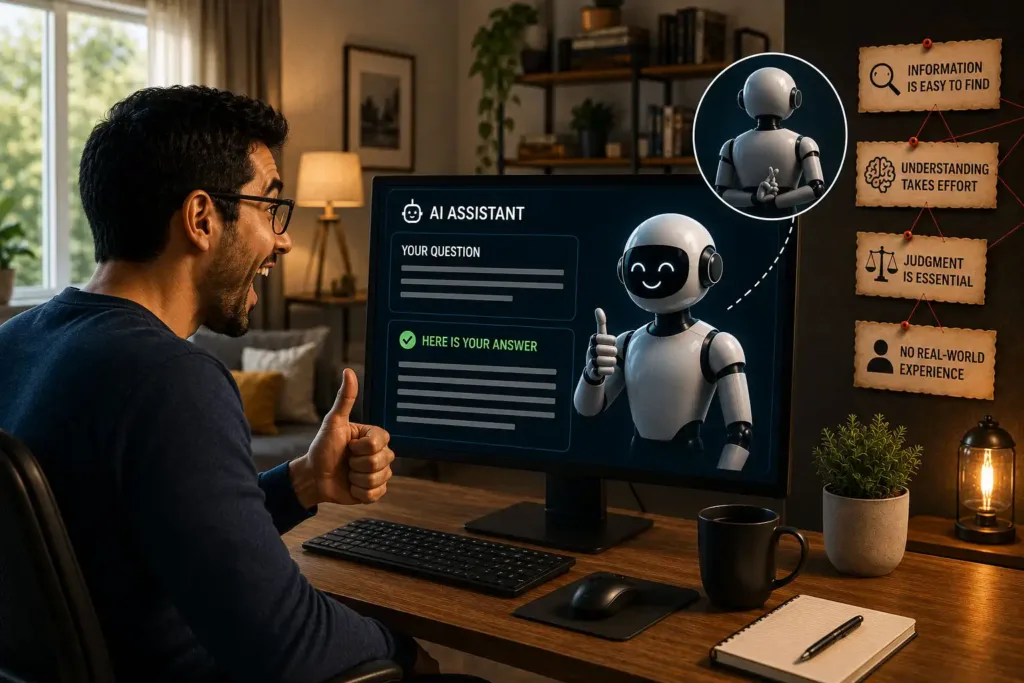
Today, a child researching a school project, a university student preparing for exams, a parent researching products, a business owner planning a new venture, or a company evaluating technology solutions can all ask AI a question and receive an answer within seconds.

 No searching.
 No comparing sources.
 No opening multiple tabs.
 No reading through pages of content.

Just an answer.

The convenience is remarkable. But convenience often comes with tradeoffs.
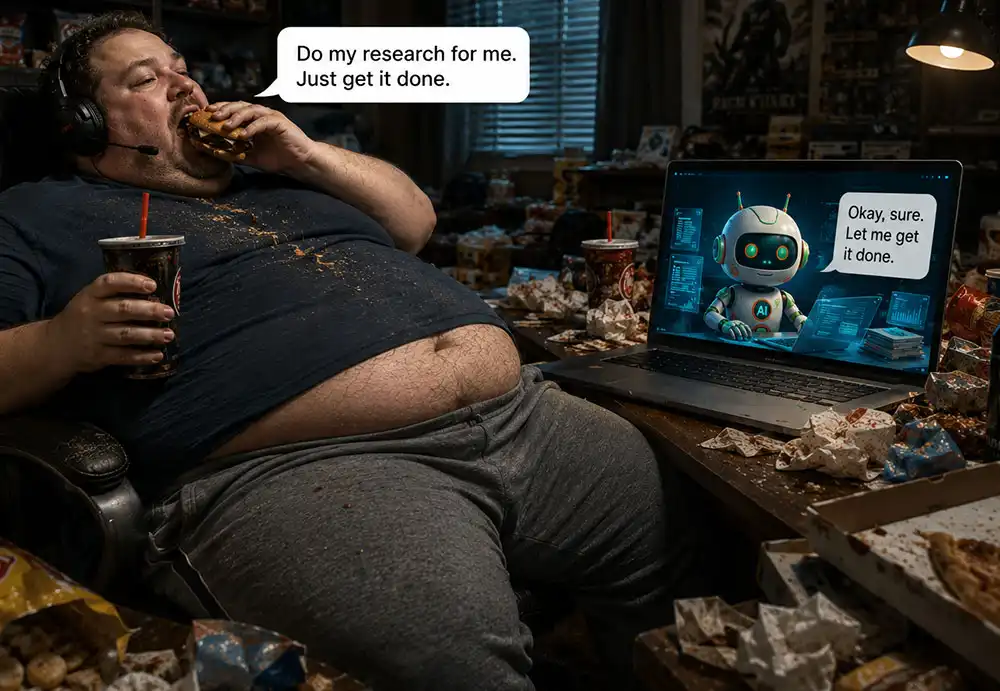
When search engines became popular, they made information easier to find, but they still required us to think. We compared sources, evaluated opinions, challenged assumptions, and ultimately reached our own conclusions. Search engines helped us find information, but they did not do our thinking for us. AI has changed that relationship. Today, many people ask a question and accept the first answer they receive. We no longer spend as much time comparing sources, verifying information, or asking where an answer came from. In many cases, AI has become both the researcher and the presenter.

Have we become a little lazy when it comes to research?

After all, when an answer appears in seconds and sounds convincing, it is tempting to accept it and move on. But convenience should never replace critical thinking, especially when important decisions are involved.
Perhaps we have simply become accustomed to getting answers instantly.
Whatever the reason, one thing is becoming increasingly clear.
The easier it becomes to get answers, the less time we spend questioning them.
And that may be the most important conversation of all.

The Difference Between Information and Understanding

Twenty years ago, if someone gave you advice, one of the first questions you might ask was:

“How do you know that?”

Today, AI provides answers with such confidence and speed that many people never stop to ask where the information came from.

That is not because AI is bad.
It is because AI is exceptionally good at presenting information in a way that feels authoritative.
The challenge is that information and understanding are not the same thing.
Knowing something exists is different from understanding why it exists.
Reading about a solution is different from implementing it.
Explaining a concept is different from having years of experience applying that concept in the real world.
This distinction becomes incredibly important when important decisions are involved.

So How Does AI Actually Work?

One of the biggest misconceptions about artificial intelligence is that it somehow knows everything.
It doesn’t.
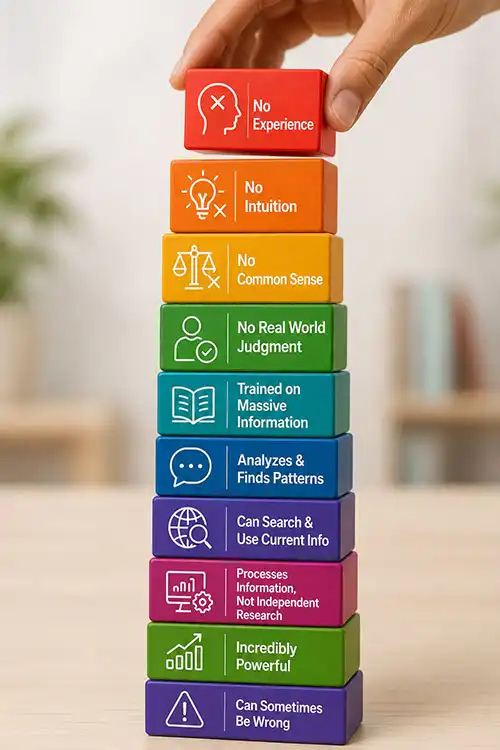
AI does not possess experience, intuition, common sense, or real world judgment in the way humans do. Instead, AI systems are trained using enormous amounts of information gathered from books, articles, websites, documentation, research papers, public discussions, and countless other sources.
When you ask AI a question, it analyzes your request, identifies patterns within the information it has learned, and generates what it believes is the most relevant response.
Some modern AI systems can also search the internet, review recent information, compare sources, and include current findings in their answers.
The important thing to understand is that AI is not independently researching a topic the same way a human expert might. It is processing information, identifying patterns, and presenting conclusions based on the information available to it.
That makes AI incredibly powerful.
But it also explains why AI can sometimes be wrong.

The Internet Contains the Best Information and the Worst Information

The internet is one of humanity’s greatest achievements.
It gives us access to an extraordinary amount of knowledge.
Unfortunately, it also gives us access to misinformation, outdated advice, biased opinions, marketing disguised as facts, and content created by people with little or no practical experience.
AI does not live in a world separate from the internet.
It learns from information.
And information is not always accurate.
Most of the time, AI does an impressive job of identifying useful information and presenting it clearly. However, it cannot always distinguish between information that is technically correct and information that is practically useful. It may not understand missing context, business constraints, unique project requirements, or lessons that only come from years of real world experience.
That is why AI should be viewed as a powerful research assistant rather than an unquestionable authority.

When AI and Experience Disagree

This is where things become particularly interesting for businesses.
Imagine a company approaches a software development team with a new project.
After reviewing the requirements, the developer prepares a proposal explaining what needs to be built, how it should be approached, and how long the work is likely to take.
The client reviews the proposal.
Then, like many people today, they copy the entire proposal into AI and ask a simple question:

Does this estimate make sense?

A few seconds later, AI provides an answer.

Sometimes the answer may be useful.
Sometimes it may be partially correct.
Sometimes it may be completely inaccurate because it lacks the context, technical details, project history, and business requirements that the developer already understands.

Yet it is becoming increasingly common for clients to challenge experienced professionals based solely on an AI generated response.
Think about that for a moment.
On one side is a professional who may have spent years building websites, developing software, managing infrastructure, solving technical problems, and delivering projects for real clients.
On the other side is a system that generated an answer in a matter of seconds based on patterns found in information.

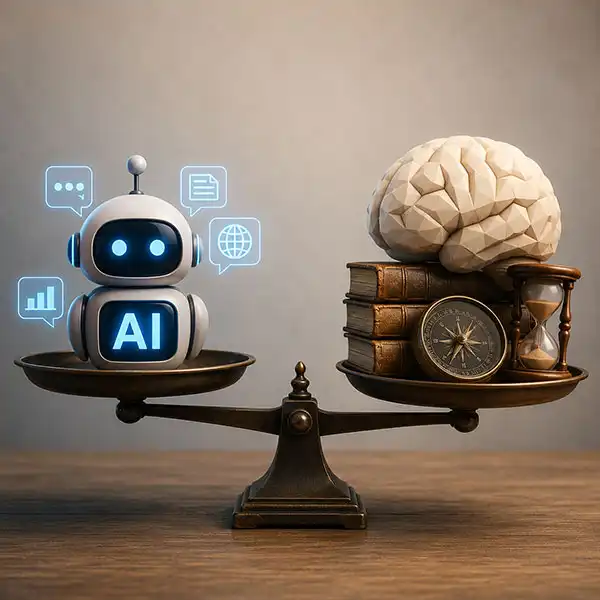
Both have value.
But they are not equal.

And they are certainly not interchangeable.

Experience Solves Problems That Information Cannot

Imagine reading a manual about how to fly an airplane.
You could spend weeks studying every page and memorizing every procedure.
Would that make you a pilot?
Of course not.
Because experience is not simply information stored in your mind.
Experience is knowledge tested under real conditions.
It comes from making mistakes, solving problems, adapting to unexpected situations, and learning what works when theory meets reality.
The same principle applies to software development, web development, cybersecurity, business strategy, and virtually every professional field.

AI can explain how something should work.
Experience understands what happens when it doesn’t.

AI can suggest solutions.
Experience understands consequences.

AI can provide possibilities.
Experience understands practicality.
That difference matters more than ever.
The Smartest Businesses Use Both

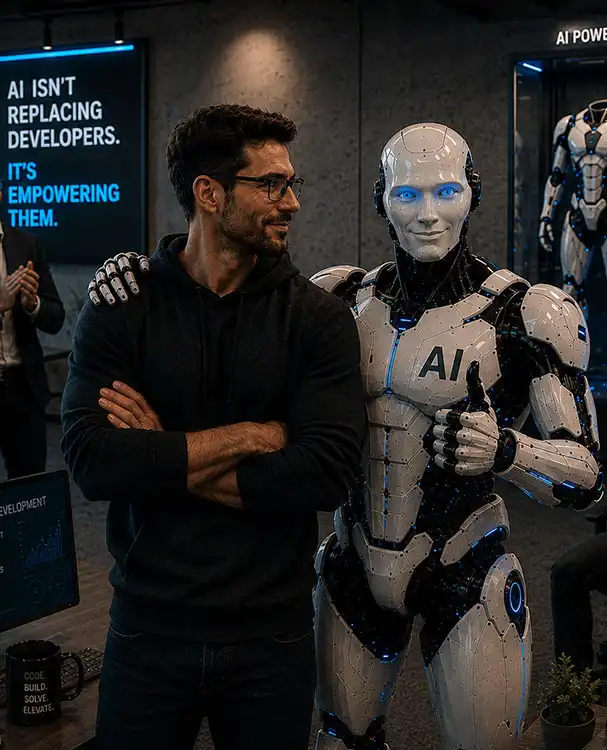
The goal is not to choose between AI and human expertise.
The most successful businesses are learning how to combine them.
AI can accelerate research, generate ideas, summarize information, and help teams work more efficiently. It is an incredible tool that continues to transform the way businesses operate.
At the same time, experienced professionals provide context, judgment, practical knowledge, and accountability that no technology can fully replace.
The strongest decisions often come from using AI to gather information and experienced professionals to validate, interpret, and apply that information correctly.
That combination delivers the best of both worlds.

Why Experience Still Matters

 Technology will continue to evolve.
 AI will continue to improve.
 New tools will continue to emerge.
 But one thing is unlikely to change.
 Experience still matters.
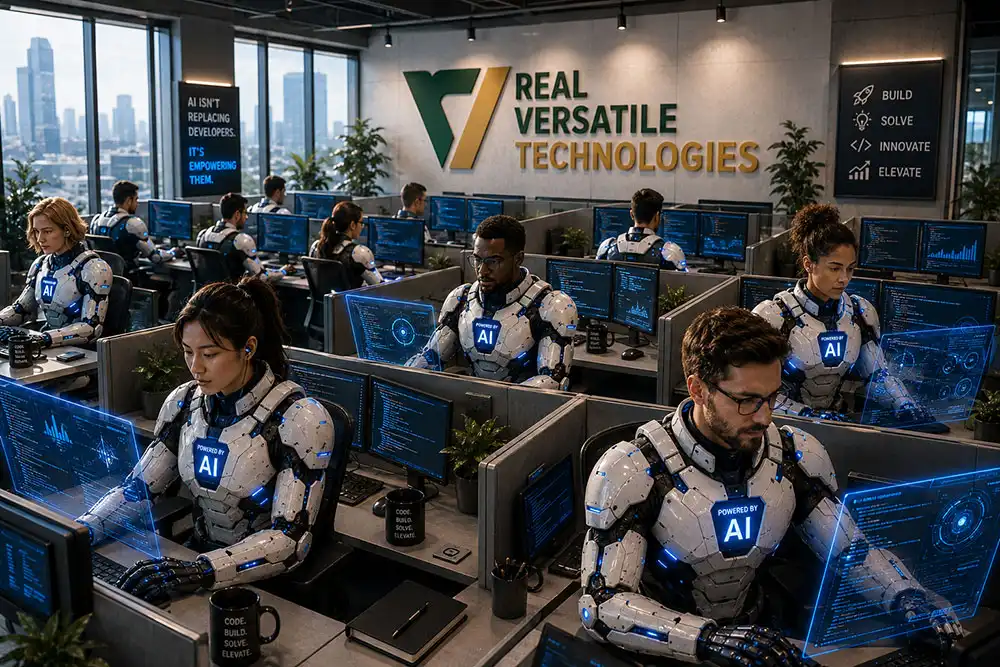
When budgets are on the line, when deadlines matter, when security risks exist, and when business decisions have long term consequences, there is tremendous value in speaking with people who have spent years solving similar challenges.
Technology can provide answers.
Experience helps determine whether those answers are actually right.

Why Businesses Trust ReaverTech

At ReaverTech, we embrace modern technology, including AI, because we understand the value it brings to businesses and professionals.
However, we also understand that technology alone is not enough.
Successful projects require planning, judgment, technical expertise, and years of practical experience. They require understanding not only how something should work in theory, but how it performs in the real world.
Our team has spent years helping businesses build websites, develop software, implement technology solutions, solve complex technical challenges, and make informed decisions. Long before AI became part of everyday life, experienced developers and technology professionals were helping businesses navigate the same challenges they face today.
That experience remains one of our greatest strengths.

Final Thoughts

AI is one of the most powerful tools ever created.
It can help us learn faster, work smarter, and access information more efficiently than ever before.

But it is still a tool.

The next time AI provides an answer, take a moment to ask yourself a simple question:

Am I looking at information, or am I looking at expertise?

The answer may not always be the same.

If you are planning a new website, software project, business platform, automation solution, or technology investment, there is real value in having experienced professionals review your ideas and help validate your direction.
At ReaverTech, we combine modern technology with years of real world experience to help businesses make smarter decisions and build solutions that last.

Have an idea, a project, or a technical challenge you'd like to discuss?

Get in touch with our team today. We'd be happy to help.

Categories: